Telemetry Technology - NASA Spinoff Homepage
Computer Technology
Next page
New low-cost telemetry collection products have been made available to the commercial aerospace community by taking advantage of NASA's technology transfer program.
In 1990, Avtec Systems, Inc., located in Fairfax, Virginia, developed its first telemetry boards for Goddard Space Flight Center. Since that time, Avtec has provided innovative, flexible telemetry board and system designs which keep costs low and reliability high. Avtec's customer base has quickly expanded to include a number of NASA centers, major aerospace firms, and a diverse set of commercial and government buyers.
"Over the years, we have worked closely with NASA engineers to design products that meet the needs of the NASA community. We have leveraged this technology to serve the needs of the commercial aerospace community as well," says Avtec's Mary Ellen Orsino, manager of marketing and sales.
Avtec products now include PC/AT, PCI, and VME-based high speed I/O boards and turnkey systems. By building intelligence into its boards, high data rates can be attained without burdening the host central processing unit.

| Commercial sales of Avtec telemetry hardware was founded on NASA transferred technology. |
In addition to Avtec's board-level products, the company offers complete turnkey systems for telemetry acquisition, data quality monitoring, bit error rate testing, and high speed data logging. Along with high speed bidirectional telemetry boards, the company integrates third party products to support several functions, including receiver, bit synchronizer, time code processor, and others as required.
From the beginning, Avtec boards were designed with flexibility in mind by implementing board functionality on Field Programmable Gate Arrays (FPGA). Then, as additional functions were developed, the same board could be used by swapping logic modules. The result? Cost savings to the customer by providing for multiple uses of the same board designs. Additionally, by providing bidirectional capability (both frame synchronization/decommutation and PCM simulation) on a single board, Avtec has matched what competitors charge for unidirectional boards.
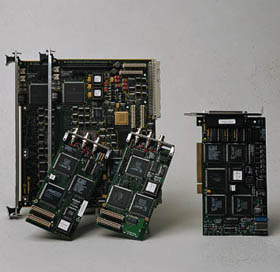
| One of Avtec's product lines uses NASA-designed Reed-Solomon Decoder chips. |
The most recent and most successful technology transfer from NASA to Avtec is the Programmable Telemetry Processor (PTP), a personal computer-based, multi-channel telemetry front-end processing system originally developed to support the NASA communications (NASCOM) network. The PTP performs data acquisition, real-time network transfer, and store and forward operations.
There are over 100 PTP systems located in NASA facilities and throughout the world. Widespread NASA support of PTP is a result of its low cost and flexible design. Since commercializing the PTP, Avtec has added even more capabilities, created a commercial documentation package, and provides top-notch technical support on the hardware and software for the systems they sell.
"Our NASA customers have responded enthusiastically," says Avtec's Orsino. "We recently delivered over 100 systems to Goddard's NASCOM division for the NASCOM-IP transition, resulting in over $1.5 million in sales for Avtec," she says.
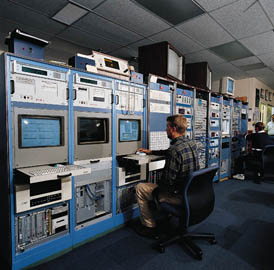
| Avtec has provided telemetry hardware in support of NASA's Communications Network (NASCOM). Shown are NASCOM boards at Goddard Space Flight Center's Simulations Operations Center. |
PTPs are scheduled to be used to support Landsat-7, and Stanford University's Gravity Probe B Relativity experiment. "We are also working with many other NASA and commercial aerospace customers, selling PTPs for use all over the world," Orsino adds.
Telemetry Technology - NASA Spinoff Homepage
Commercial sales of Avtec telemetry hardware was founded on NASA transferred technology.
NASA Spinoff Homepage
Polymers Advance Heat Management Materials for Vehicles Under NASA funding, a private company enhanced and refined a polymer material that was incorporated into a
NASA Technologies Benefit Our Lives - NASA Spinoff Homepage
Space exploration has created new markets and new technologies that have spurred our economy and changed our lives in many ways. This year, NASA unveiled two new
Apollo Spinoffs - NASA Spinoff
With the success of the Apollo program, NASA delivered great progress in the fields of rocketry and aeronautics, as well as the fields of civil
Kennedy Space Center Technology Transfer Office
NASA's Office of the Chief Technologist. Find out more about NASAs Office of the Chief Technologist. Visit NASA's OCT Web site
Spinoff Frequently Asked Questions - NASA Spinoff Homepage
What is the difference between a NASA spinoff and a NASA success"? A spinoff is a commercialized product that incorporates NASA technology or
NASA Headquarters | NASA
NASA Headquarters, in Washington, provides overall guidance and direction to the agency, under the leadership of the Administrator. Ten field centers and a
NASA spin-off technologies - Wikipedia, the free encyclopedia
Mistakenly attributed spinoffs . The following is a list of technologies sometimes mistakenly attributed to NASA. In some cases, NASA popularized technology or aided
NASA Science
News and features about NASA research, aimed at the general public. Includes sections on astronomy, space science, beyond rocketry, living in space, earth science
Science and Technology
The Jet Propulsion Laboratory is involved in many different science and technology research tasks. JPL is involved in several partnerships and collaborations to


Comments
Post a Comment